
Agentic Finance: Beyond Cost-Cutting, But Productivity-Unlocking
From OpenAI and Google’s internal finance workflows, a clearer picture is emerging of how AI agents may rewrite the CFO Suite.

Since hosting an Agentic Commerce event in Shanghai on June 18, I’ve noticed a shift in the conversations around this space.
The field is still early. There is no real consensus yet. But the questions are getting sharper.
Only a few months ago, most discussions around Agentic Commerce still circled around the obvious consumer scenarios: Will AI agents shop for us? Will they compare products? Will they click the buy button? Will merchants need to optimize for agents instead of humans?
But in more serious conversations, especially with builders, fintech operators, and payment people, the discussion quickly moved one layer deeper. Where will real transaction volume come from? How will agent identity and authorization be established? Who owns the wallet, the account, the routing, the risk engine, the compliance layer, the settlement rail? How do Google, Coinbase, Circle, Stripe, Visa, and Mastercard differ in their approaches?
That shift matters. It means the debate is no longer about whether machines can technically initiate a payment. The real question is whether a machine has the right to move money on someone’s behalf, and who is responsible when that right is exercised.
Yet because this Agentic Commerce narrative is so natural, another equally important direction has been somewhat hidden in plain sight.
Most people still approach Agentic Commerce through a B2C lens. An AI agent helps a consumer discover products, compare prices, place an order, and make a payment. Merchants need better product data, pricing feeds, inventory accuracy, checkout readiness, and risk controls. Payment networks need to know whether an agent-initiated transaction was truly authorized by the user. Issuers and networks need new ways to think about fraud, chargebacks, disputes, and liability.
All of that is important. It is also the language the payments industry already understands.
But money does not start moving only when someone clicks a payment button.
In the broader economic system, money starts moving much earlier. It hides inside budgets, purchase requests, contract terms, vendor onboarding, invoice discrepancies, cash forecasts, tax treatment, and audit trails. In consumer Agentic Payments, the question is whether an AI agent can buy something for me. In corporate Agentic Finance, the question is whether an organization can make capital, contracts, budgets, procurement, cash, and risk judgment move faster and more accurately.
That is why the recent internal finance workflow disclosures from OpenAI and Google are worth looking at separately.
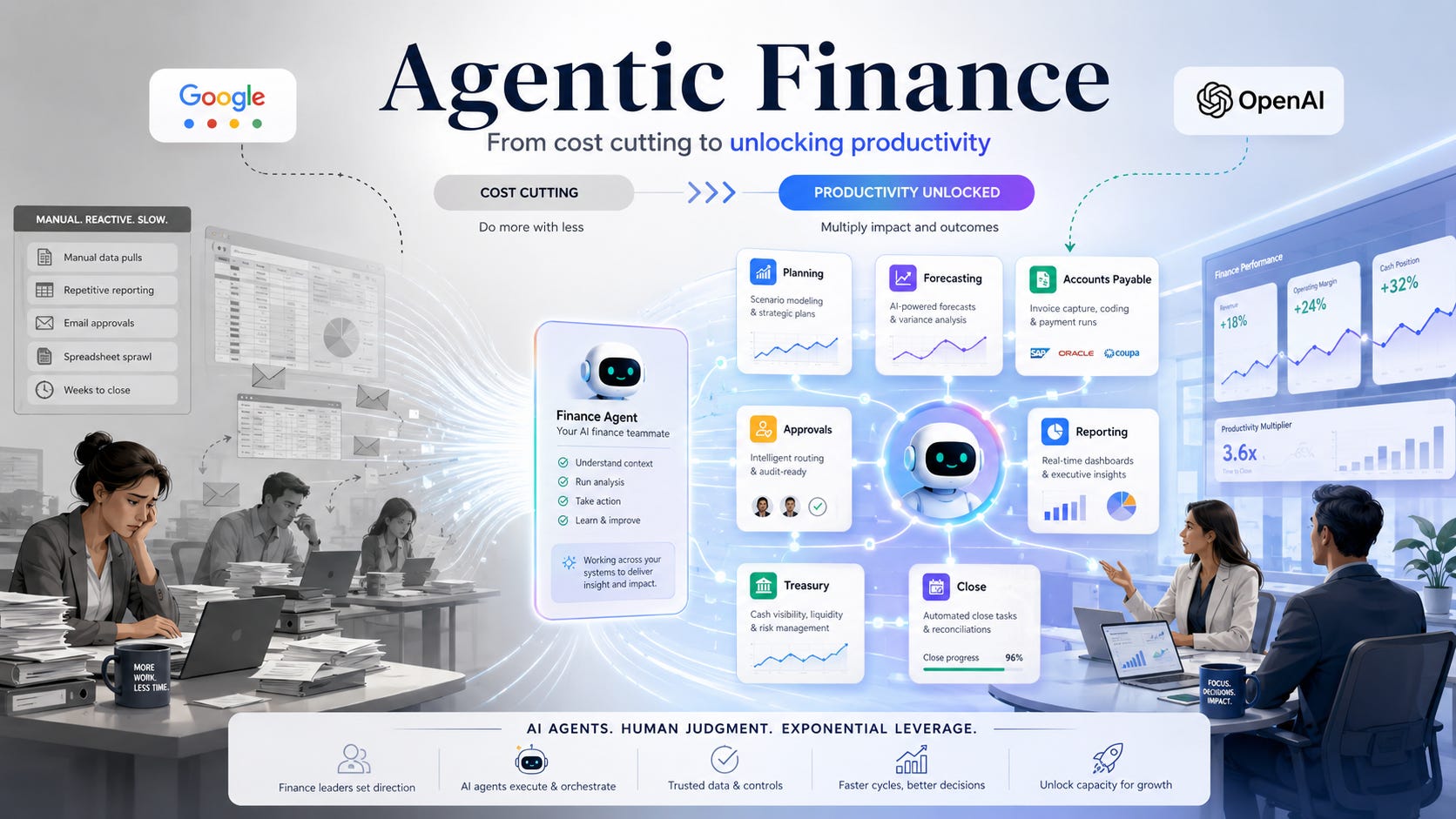
In May, OpenAI and PwC announced a collaboration to build AI agents around the core rhythms of the CFO office, including planning, forecasting, reporting, procurement, payments, treasury, tax, and accounting close.
The interesting part is not that PwC wants to advise CFOs on AI. That would be unsurprising. The interesting part is that the work starts inside OpenAI’s own finance organization, with a procurement agent, before extending the lessons into broader enterprise finance workflows.
OpenAI also said it has already been using ChatGPT and Codex internally to support investor relations, treasury, tax, reporting, corporate development, and contract review.
Google’s example feels more like a stress test inside a large and complex organization. According to recent reporting, Google’s finance team uses an AI agent to automatically compare vendor invoices against contract terms, increasing invoice review throughput by five times and potentially reducing $200 million in annual overpayments.
In treasury, Google is also using AI to manage cash across thousands of bank accounts, recommend investments for excess cash based on risk tolerance, and, after human review, allow another agent to execute transactions.
The most revealing detail is not just the efficiency gain. It is that Google’s finance team has stayed roughly the same size while producing more. People who used to work on invoice validation have moved toward higher-level audit and AI review work.
This is not a chatbot bolted onto the CFO Suite. It is not RPA with a large language model wrapper.
Over the past several years, the SaaS market has already gone through a full wave of CFO Suite innovation. Accounts payable automation, expense management, procurement, FP&A, close management, treasury dashboards — every category produced new companies, and almost every pitch deck sounded similar: reduce manual work, automate workflows, increase efficiency, shorten the close cycle, cut costs.
None of that was wrong. It was just incomplete.
Keep reading with a 7-day free trial
Subscribe to Fintechnize to keep reading this post and get 7 days of free access to the full post archives.